
A credit report is just a record of how you've used credit: who you owe, whether you pay on time, and a few facts about you. It looks intimidating because it's dense, not because it's complicated. Read it section by section and it gets simple fast.
First, the 30-second version of what this document even is. A credit report is a file that one of the three nationwide credit bureaus (Equifax, Experian, and TransUnion) keeps on you. Your lenders and card issuers send them updates on your accounts month after month, and the bureau compiles those updates into a history: what you've borrowed, what you owe now, and whether you've paid on time. It isn't a score, and it isn't a verdict on you as a person; it's the raw record a score is later calculated from. Each bureau builds its own copy, which is why the three don't always agree.
The sections you'll see
- Personal information: names associated with you, addresses you've lived at or used for mail, and your employment history. Check these first. An old address or a minor spelling difference is usually harmless on its own, but a name or address you don't recognize can be an early sign of a mixed file or identity theft, where someone else's information gets tangled up with yours.
- Accounts (or "tradelines"): every credit card, loan, and line of credit, with the balances and limits that drive your utilization, plus your payment history.
- Inquiries: a list of who's looked at your report, and whether it was a hard pull (you applied for something) or a soft one (a check that doesn't affect your score).
- Public records and collections: bankruptcies, and debts that were handed to a collection agency.
What to actually look at
Read each account like a line on a bill. Is the balance right? Is the payment history right? Do you recognize it at all? You're not grading yourself; you're checking the record for things that don't match reality.
Why it's worth doing
About 44% of Americans' credit reports contain an error, 27% serious enough to hurt a score (Consumer Reports / WorkMoney, 2024). You can't fix what you've never read. And reading your own report is free and has no effect on your score.
You don't have to read three dense PDFs
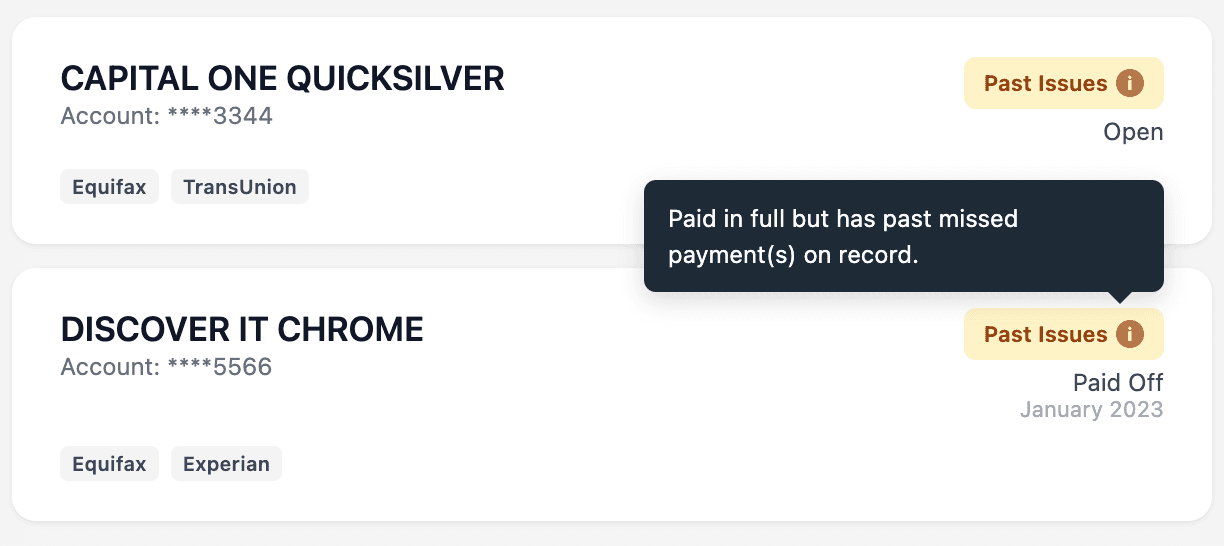
Pulling your reports from AnnualCreditReport.com is free, but they arrive as separate, dense documents, and lining them up by hand is where a lot of people stall. Solid Credit reads your report and lays it out as clean, plain-English cards: each account with its status spelled out and a chip for every bureau reporting it, so you can see what's there without decoding it. Free lays out any report you upload this way; with Premium, Equifax, Experian, and TransUnion come together in one view automatically, so an account that differs between bureaus is obvious at a glance.
Common questions
Where can I get my credit reports for free?
At AnnualCreditReport.com, the official site backed by federal law. You can pull all three (Equifax, Experian, and TransUnion) for free, and checking your own report never affects your score.
How often should I actually check my report?
A few times a year is plenty for most people, plus once before any big application like a mortgage or car loan. Because it's free and has no score impact, there's no harm in looking more often.
I spotted something that doesn't look right. What now?
Write down the item and what's actually true, then confirm whether it's inaccurate, incomplete, or not yours. If it fails any of those, it's something you can dispute. Our guide on what counts as a credit report error walks through the difference.
Do I really need to read all three reports?
Yes. The three bureaus often hold slightly different information, so an error can sit on one report and not the others. Reading them side by side is the fastest way to catch what doesn't match, which is exactly what Premium puts in one view across your Equifax, Experian, and TransUnion reports.
What's the difference between my credit report and my credit score?
The report is the underlying record of how you've used credit; the score is a single number calculated from it, and how a credit score actually works breaks down the factors that go into it. Correcting the report is what can move a score (how much depends on the rest of your file and the scoring model), which is why the report is the thing worth reading.